4 posts tagged with "puzzles"

Details about puzzles, riddles and logical thinking

View All Tags

The reason I became a professional musician

· 3 min read
Ross Mitchell
Ross Mitchell
Sound and Music

Video game music is the reason I became a professional musician​

No, that’s not an exaggeration, I genuinely mean it. It all started with the first game that truly gripped me, that pulled me into its surreal and twisted world and wouldn’t let me go - The Legend of Zelda: Majora’s Mask. I remember being 6 years old and sitting in front of my CRT TV, ridiculous 3-pronged N64 controller in hand, and watching in horrified amazement as the cheerful Clock Town theme gradually transformed into an oppressive nightmare during the final hours before Moonfall. I remember having the Termina Field theme (an expanded version of the Zelda series main theme) stuck in my head when walking everywhere. And of course, most of all, I remember using the Ocarina of Time to weave together music and magic to travel through the fourth dimension.

A few years later, when I had an option to join my elementary school’s band, I was somewhat miffed by the fact that they wouldn’t let me play ocarina in the band, so I settled for the flute. I mean, the ocarina is basically just a potato-shaped flute, right? So, I started doing my best impression of Link’s calm ocarina-playing-pose and dove headfirst into the wonderful world of woodwinds. I loved playing the flute, but what bothered me most about it was simple limitation - flutes can only play one note at a time (notwithstanding advanced multiphonics techniques), and it was impossible for me to create music that was as engaging as what I fell in love with in The Legend of Zelda. I needed something more.

From there, my musical journey turned towards the piano - ah ha, now there’s an instrument that can stand on its own! I was immediately enamored with my new instrument, and stopped playing the flute so I could devote more time to it. I fell in love with the works of the classical masters, especially Alexander Skryabin and Claude Debussy, but always felt an itch to make my own music.

While my early (embarrassing) attempts at composition are thankfully lost, I found joy in making arrangements of my favorite video game tunes. The one I was most proud of was - of course - a medley of Zelda music that started with the slow title theme to the NES Legend of Zelda, progressed to the adventurous “Great Sea” theme from The Windwaker, reached a crisis point in the “Palace Theme” from Zelda II: Adventure of Link (most will know this from Super Smash Bros. as the music that plays in the “Temple” stage), before concluding with a triumphant and rousing rendition of the series main theme. Looking back, I realize that what brought me the most joy in arrangements like this was the creation of a musical narrative, using naught but notes to take listeners on a journey filled with hope, struggle, and celebration.

Now, years later, after much study and practice, I am fortunate enough to be able to create entire soundworlds of my own. Tales from Wendmor is not just any old MMORPG - it is a learning platform designed to encourage wonder and curiosity. A unique world like this deserves an equally unique soundworld - one that captures the imagination the same way that Link’s ocarina captured mine - and that is precisely what I intend to bring to life.

Mystic Chord Music

A Gentler Introduction to Maps

· 2 min read

This week I have been working on another map interface for Tales from Wendmor.

Our existing map questions are fairly direct, which works well once you already have some geographical knowledge. But it is quite a demanding way to get familiar with maps in the first place. I was trying to focus on simply building a matter-of-fact familiarity with the world map, so I have been experimenting with a gentler version.

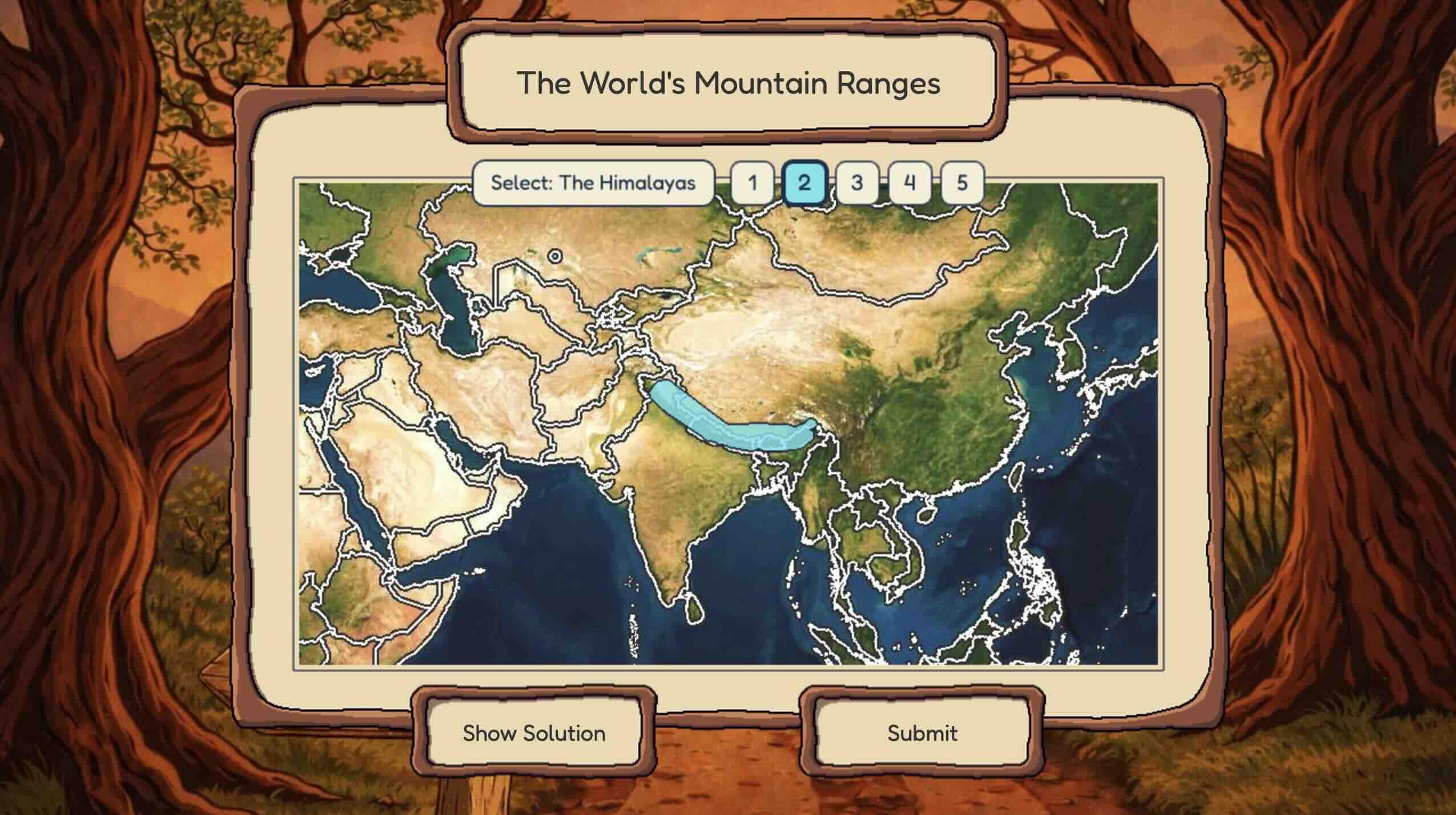
Instead of asking the player to locate something from scratch, we show several (usually five) possible locations. The player can move between them using tabs, inspect the different maps and decide which one they think is correct. We mark regions on the map that are not necessarily countries, but geographical features worth becoming familiar with — in this example, the Himalayas.

Choosing a mountain range

Players with existing map familiarity will not find these questions difficult and will breeze through them. For them, MMM will kick these questions into the long grass and quickly unlock follow-up questions at a higher difficulty level. For everyone else, it is a quick and gentle exercise in building visual familiarity with the map — making use of our strong ability to remember places, shapes and spatial relationships.

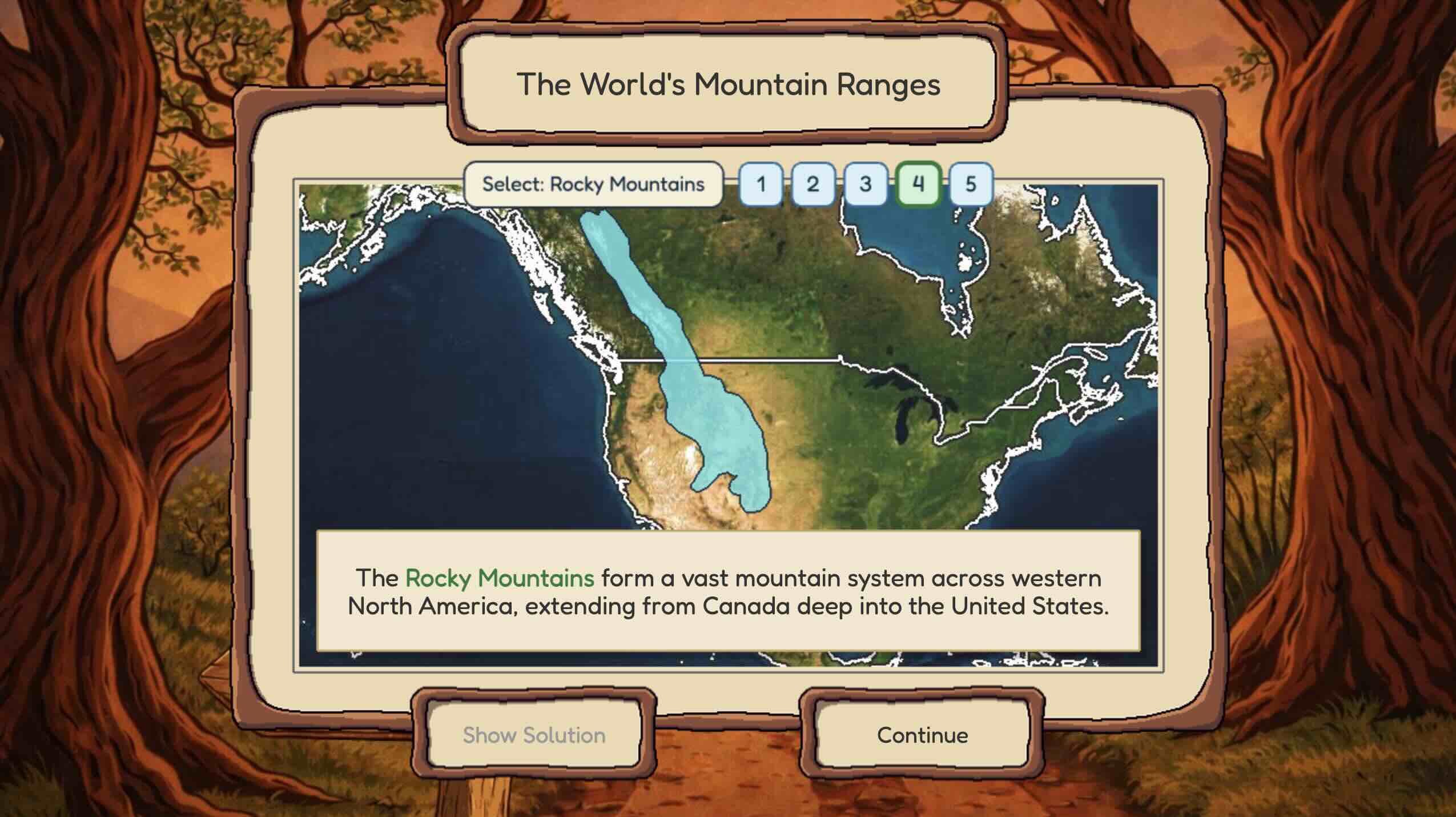
After submitting, the correct location is revealed and the player can look at it before continuing.

Reviewing the correct location

We are currently using the interface for a large set of the world's mountain ranges and are extending it with other useful information that can be placed on a map - more on this in a later post.

Discuss this post on Substack →


Find Me

· 2 min read

Today, I have finished the map-quizzing system in Tales from Wendmor.

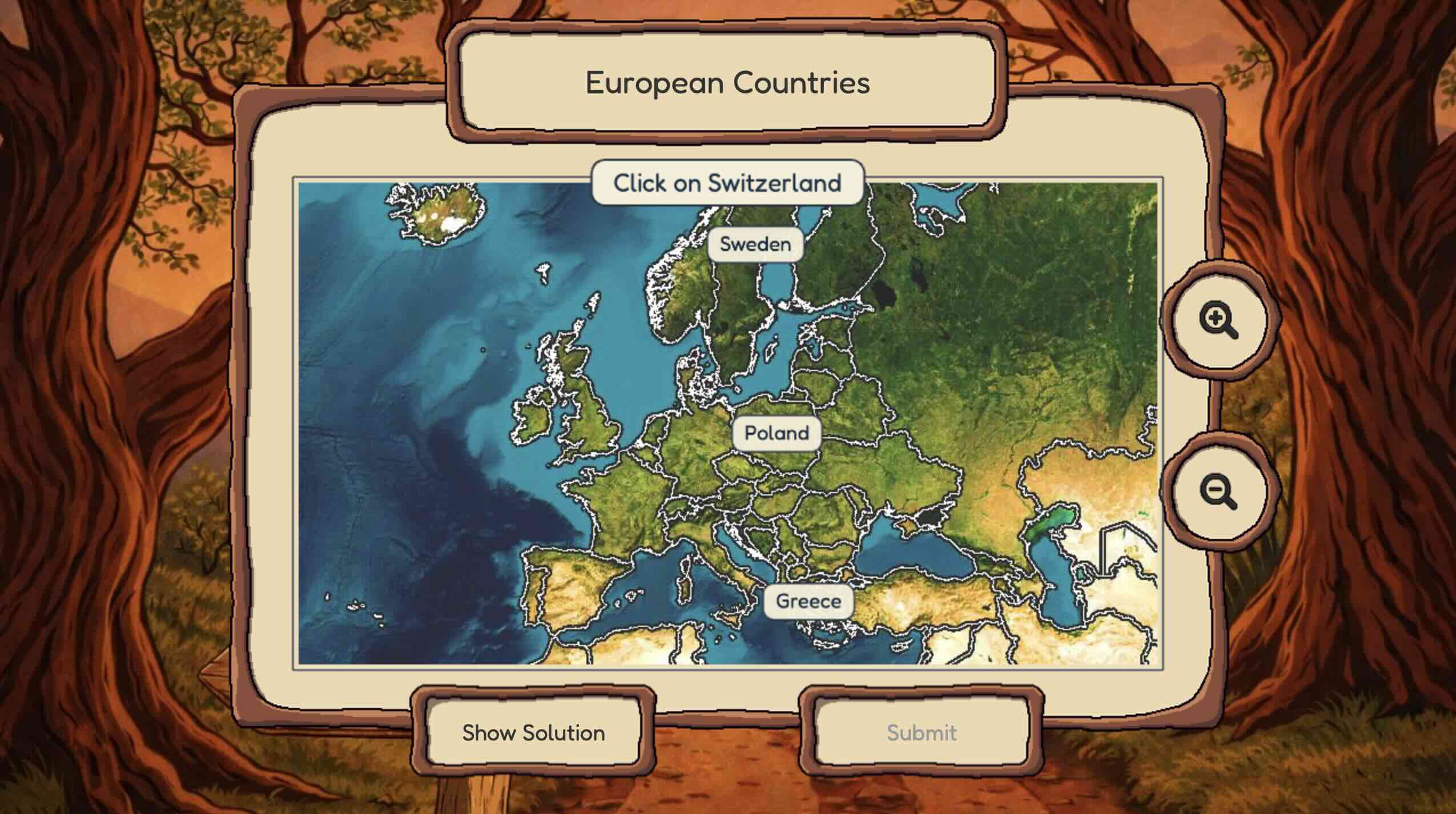
At the simplest level, the interface offers straightforward geography questions: the game shows a map, and asks the player for a country or a region. It will mainly be used for map quizzing, but in principle, this can be used to quiz areas on any image, like the parts of a plant cell or the parts of a volcano diagram.

The interface supports bulk mode, where we bundle a large number of related questions into one. In our European countries quiz, there are more than 50 countries to identify, and we quiz them in batches of 5. We have tested different bulk sizes for a while, and 5 seems to be a good compromise. Just firing up a single map question from time to time feels a bit short-lived and disjointed. Larger batches turn what should be a quick-to-answer quiz question into a chore.

Map quizzing

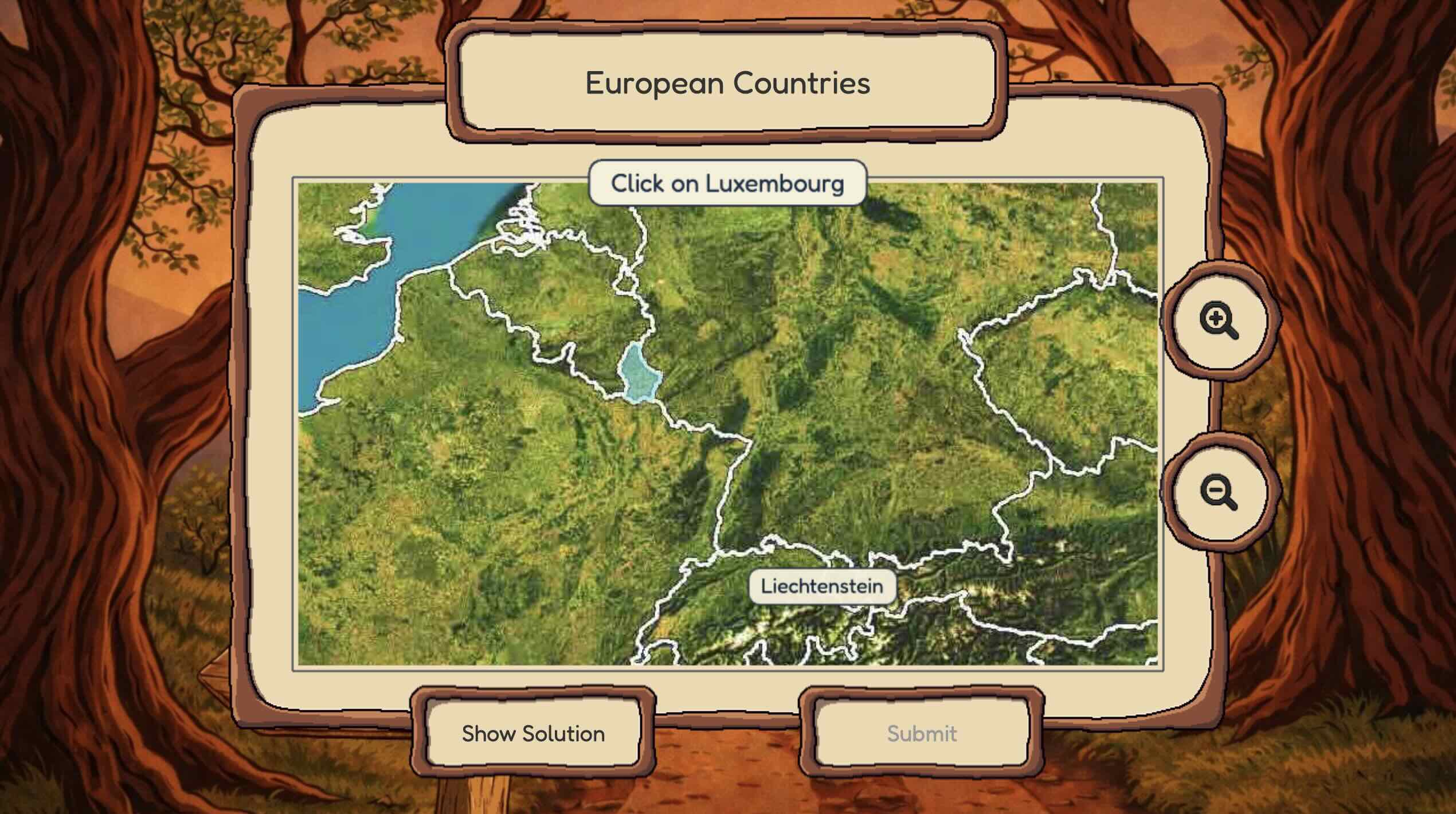
The UI supports a Show solution for each country. There is also a zoom that comes in useful when chasing small countries and city states.

Map quizzing

After submitting a batch of 5, the correct answers are revealed.

We call this type of quiz a Find Me. What makes it interesting for cognition is that each of the questions is modeled separately with its own forgetting curve. Questions the player finds easy (e.g. find Italy) and those that they find harder (e.g. find Kosovo) are on different revision schedules. The spacing algorithm (MMM) prioritizes questions that are most likely to be in the goldilocks zone for retrieval, where the spacing effect is at its peak.

I will go into more details of MMM in a future post.


Discuss this post on Substack →

Support of Visual Matrix Puzzles

· 2 min read

This week we have been working on a small domain-specific language for defining the logic puzzles in Tales from Wendmor.

These puzzles are inspired in part by the kind of visual matrix problems used in classic IQ tests, especially Raven-style progressive matrices: a grid of shapes follows an underlying rule, one part is missing, and the player has to infer the pattern. Traditionally these are static puzzles, but we are interested in pushing the format further with movement, timing and rhythm.

Instead of hard-coding each puzzle in JavaScript, we can now describe shapes, positions, colors, answer options and animation directly in a compact puzzle DSL file. The same system handles static rules such as AND, OR and XOR grids, as well as animated patterns using movement, rotation, scaling and blinking.

The main benefit of supporting a DSL is that we can focus on the puzzle idea rather than the implementation. A rule such as “move right, grow, move back and shrink” or “blink once on the left and twice on the right” can be expressed directly and then reused with different shapes and decoys.

The animated versions are particularly interesting. The full pattern is no longer visible at a single moment and players may need to remember a rhythm or movement while looking elsewhere in the grid, turning the familiar matrix-puzzle format into something that also exercises working memory and temporal pattern recognition.

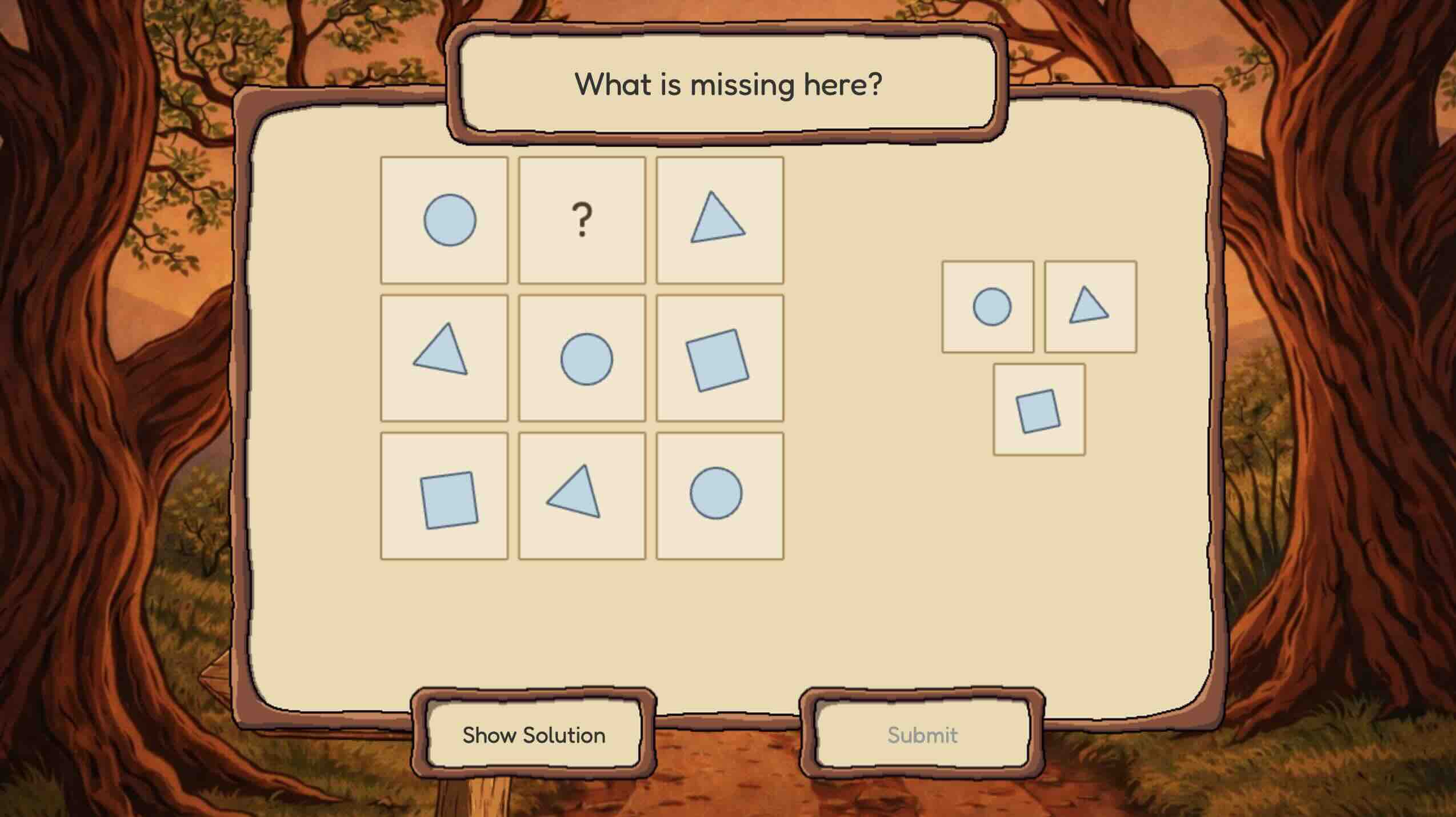
Puzzles come with difficulty and start out easy. Here is an example of a fairly simple one:

Simple Matrix Puzzle

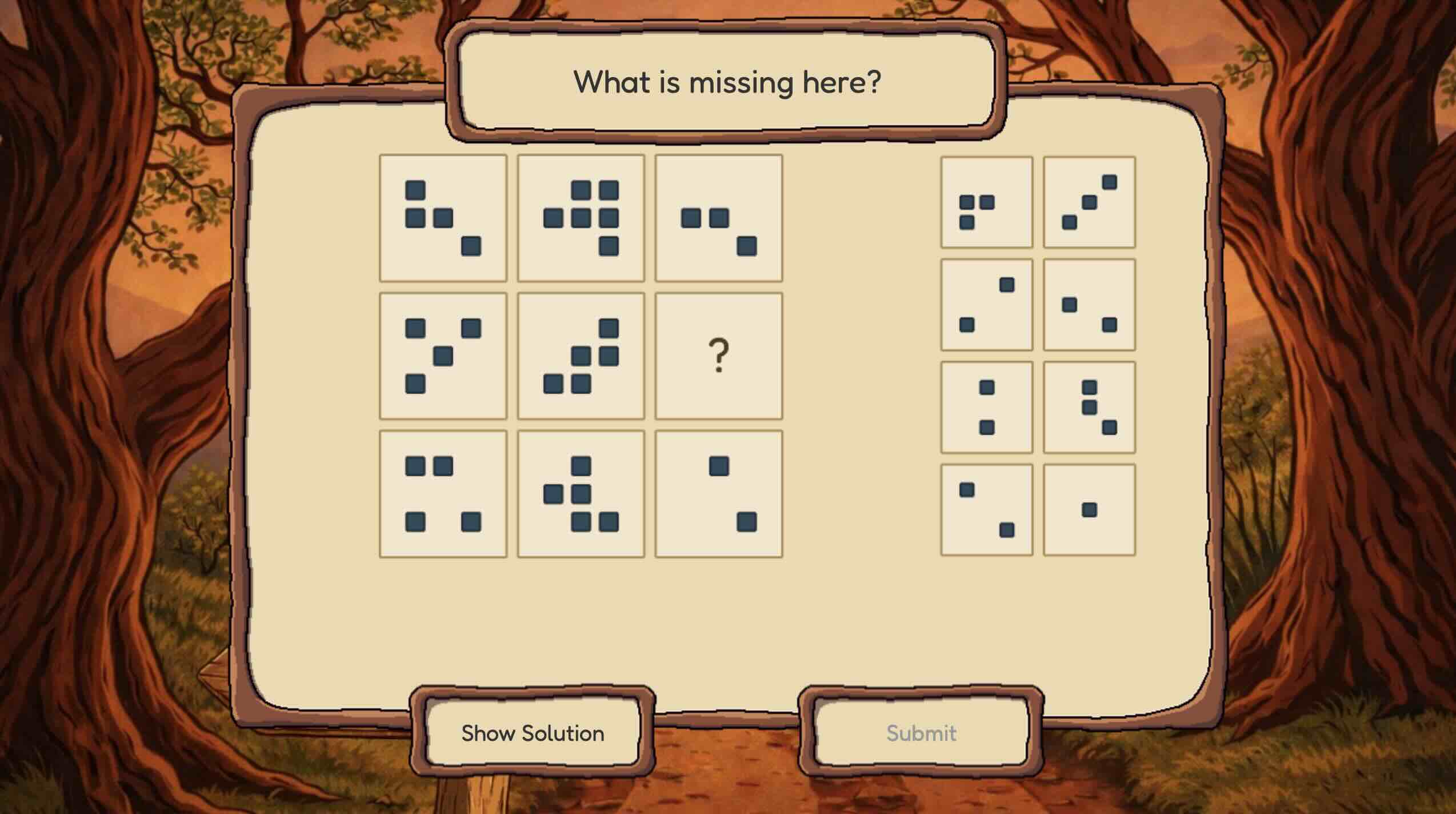
But once players get better at solving them they can get a bit more challenging like this one:

Difficult Matrix Puzzle


Discuss this post on Substack →